

- Market Size (2026)
- USD 534.8 Mn
- Forecast (2036)
- USD 3145.9 Mn
- CAGR (2026 to 2036)
- 19.4%
Smart Shoes Market Size, Market Forecast and Outlook By FMI
The smart shoes market was valued at USD 445.1 million in 2025. The market is set to reach USD 534.8 million by 2026-end and grow at a CAGR of 19.4% between 2026-2036 to reach USD 3145.9 million by 2036. Fitness Tracking Shoes will dominate with a 50.0% share, while Fitness And Sports will lead with a 55.0% share.

Summary of the Smart Shoes Market
- Demand and Growth Drivers
- Fitness and sports applications account for 55.0% of demand, reflecting growing consumer interest in real-time step tracking, gait analysis, calorie measurement, and performance optimization through sensor-embedded footwear.
- Online retail accounts for 65.0% of distribution, reflecting the technology-oriented consumer base and the effectiveness of digital marketing and direct-to-consumer sales models for smart footwear.
- Sensor-based technology accounts for 60.0% of technology demand, as accelerometers, pressure sensors, and gyroscopes enable core functionality including step counting, gait analysis, and activity recognition.
- Product and Segment View
- Smart shoes with fitness tracking capabilities are anticipated to make up 50.0% of the total demand for the product. This highlights the consumer preference for activity tracking and performance analytics in smart footwear.
- Sensor-based technology accounts for 60.0% of technology demand. Accelerometers and pressure sensors offer the basic data collection capabilities for fitness and health monitoring features.
- The end-use demand is comprised of 60.0% individual consumers, and the remainder is professional users in sports training and healthcare.
- Geography and Competitive Outlook
- China (31.19%) leads global growth, supported by domestic consumer electronics manufacturing scale and rapid connected fitness product adoption.
- North America and Europe sustain premium demand through established fitness culture and early technology adoption patterns.
- Nike (25.0%) leads, leveraging brand strength, R&D investment in sensor technology, and established direct-to-consumer digital distribution.
- Analyst Opinion
- Rahul Pandita, Principal Consultant at FMI says, 'Brands that integrate sensor technology seamlessly into performance footwear while building ecosystem connectivity with fitness apps and wearable devices are likely to define the category as smart shoes transition from novelty products to mainstream fitness accessories.'
- The smart shoes market is at an inflection point, transitioning from early-adopter novelty to mainstream fitness accessory as sensor miniaturization reduces cost and weight penalties.
- Ecosystem connectivity with fitness apps, smartwatches, and health platforms is becoming a critical differentiation factor beyond standalone shoe functionality.
- Price accessibility is the primary barrier to mass adoption, with current price premiums of 40 to 80% over conventional performance footwear limiting penetration to fitness-engaged demographics.
Key Takeaways, Market Size, and Forecast
- The smart shoes market was valued at USD 445.1 million in 2025.
- By 2036, the Smart Shoes Market is expected to be worth USD 3145.9 million.
- From 2026 to 2036, the market is projected to expand at a CAGR of 19.4%.
- The market is projected to create an incremental opportunity of USD 2611 million between 2026 and 2036.
- In 2026, fitness and sports is expected to account for 55% of the application segment, driven by growing consumer demand for real-time activity tracking, performance analytics, and connected fitness experiences.
- China (31.19%) and India (28.88%) are two of the fastest growing markets in the world.
Smart Shoes Market Definition
The market for smart shoes consists of footwear equipped with sensors, connectivity modules, and computing capabilities that enable fitness tracking, navigation, health monitoring, and lighting. Products link to smartphones and fitness platforms, providing real-time data on activity, gait and health metrics.
Smart Shoes Market Inclusions
Market Scope: The scope of the report includes all the smart shoes that are commercially available based on product (fitness tracking shoes, navigation shoes, health monitoring shoes, lighting shoes), application (fitness and sports, healthcare, lifestyle), end use (individual consumers, professional users), distribution channel (online retail, offline retail), technology (sensor based technology, connectivity technology, other technologies) and power source (rechargeable battery, non-rechargeable battery). The revenue estimates are for the period 2026-2036.
Smart Shoes Market Exclusions
The scope does not include conventional athletic footwear without embedded technology, standalone fitness trackers worn on the wrist or body, or orthopedic footwear without smart connectivity features.
Smart Shoes Market Research Methodology
Primary Research: FMI analysts conducted interviews with smart footwear product managers, sensor technology suppliers, athletic footwear retail buyers, and connected fitness platform operators across key markets.
Desk Research: Combined data from consumer electronics industry associations, wearable technology market tracking, and athletic footwear retail analytics.
Market sizing and forecasting: Bottom-up aggregation from smart footwear shipment data across fitness, healthcare, and lifestyle categories, with regional technology adoption curve adjustments.
Data validation: Cross-checked quarterly against consumer electronics shipment statistics, retail sell-through data, and manufacturer disclosures.
Why is the Smart Shoes Market Growing?
- Miniaturisation and cost reduction of sensors permit the integration of accelerometers, pressure sensors and connectivity modules into performance footwear without significant weight or comfort penalties.
- As the connected fitness ecosystem grows, smart shoes are increasingly in demand to complement the data provided by smart watches, fitness bands and health monitoring platforms..
The smart shoes market is valued at USD 534.8 million in 2026 and is expected to grow at a CAGR of 19.4% to USD 3145.9 million by 2036. Demand is driven by the intersection of fitness technology adoption, sensor miniaturization, and connected ecosystem development. The demand for fitness tracking shoes is 50.0% of the demand for products. This shows that consumers prefer activity tracking and performance analytics.
The market is moving from an early-adopter novelty to a mainstream fitness accessory. The power source demand is 70.0% of the rechargeable battery technology, which shows the consumer’s desire for long-term use without the need to replace disposable batteries. Engineering challenge: Battery life optimization remains a key.
China dominates with a CAGR of 31.19%, capitalizing on its scale in manufacturing domestic consumer electronics, the rapid growth in connected fitness adoption, and cost-competitive production that makes products more price-accessible.
Market Segmentation Analysis
- Fitness tracking shoes account for 50.0% of product share, with step counting, calorie tracking and gait analysis being the core feature set demanded by consumers.
- Distribution is led by online retail at 65.0% as the consumer demographic is technology-oriented and direct-to-consumer digital sales models work.
- 70.0% of demand for rechargeable battery power sources is driven by consumer preference for sustainability and long duration performance without battery replacement.
The smart shoes market is classified based on product, application, end use, distribution channel, technology, and power source. Demand patterns follow the curves of fitness technology adoption, the way consumers purchase electronic devices and the maturity of the connected ecosystem.
Insights into the Fitness and Sports Application Segment
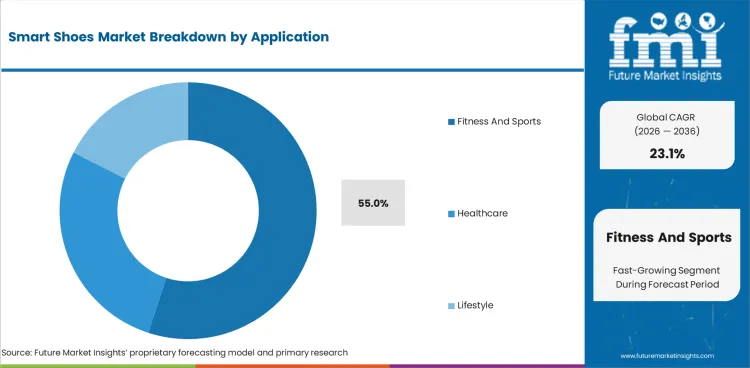
The application segment is expected to account for 55.0% of the fitness and sports sector in 2026. Most common use cases are running, walking, and general fitness activities. Smart shoes can provide step counting, distance tracking, calorie estimation, and gait analysis.
Healthcare applications are an increasing segment with smart shoes being used to monitor gait in rehabilitation, falling detection for elderly users and mapping pressure on diabetic feet for preventative care.
Insights into the Sensor-Based Technology Segment
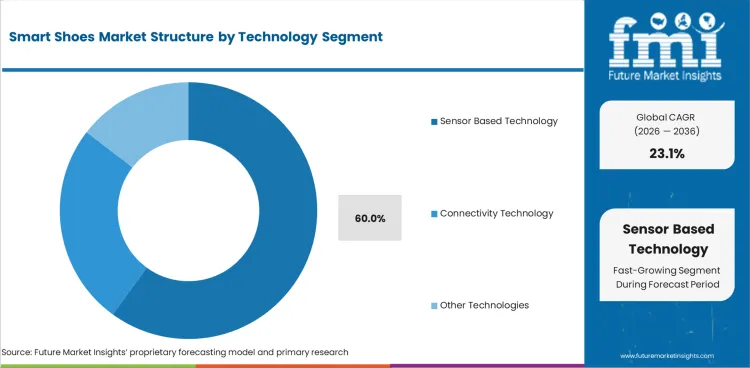
Technology demand by type Sensor-based technology 60.0% The primary data collection capabilities are provided by accelerometers, pressure sensors, and gyroscopes. MEMS sensor technology is providing better accuracy, while reducing the size and cost of components.
The second largest technology segment is the connectivity technology, such as Bluetooth and Wi-fi modules, which are used for the transmission of data to smartphones, fitness apps and health monitoring platforms.
Smart Shoes Market Drivers, Restraints, and Opportunities
- Advances in sensor miniaturization and cost reduction are making smart shoe technology more viable for mid-range price points, expanding the addressable consumer base.
- Price premiums of 40 to 80% over conventional performance footwear continue to be the biggest barrier to mass market adoption.
- Healthcare applications like gait rehabilitation and diabetic foot monitoring are opening clinical-grade demand corridors with higher margins.
The rise of connected fitness has been a driver of the smart shoes market, which is constrained by higher price points compared to traditional footwear and influenced by progress in sensor technology and the evolution of healthcare applications.
Connected Fitness Ecosystem Growth
The demand for an ecosystem of smart shoes as a complementary data source is driven by a growing number of fitness apps, smartwatches and health monitoring platforms. Shoes provide a unique set of biomechanical data that can’t be captured by wrist-worn devices such as ground contact time, foot strike pattern and weight distribution.
Price Premium Barrier to Mass Adoption
Today’s smart shoes cost 40 to 80 percent more than comparable traditional performance footwear. The price gap restricts adoption to fitness-oriented and technology-oriented demographics. The main path to broader adoption is cost reduction via sensor miniaturization and manufacturing scale.
Healthcare Application Development
Healthcare-grade demand is being created for clinical applications in gait rehabilitation, fall detection and diabetic foot pressure monitoring. These applications have higher margins and longer product life cycles than consumer fitness products.
Battery Life and Durability Engineering
Achieving optimized battery life and durability under athletic use conditions are still engineering challenges. Design and component selection are guided by minimum specification thresholds based on consumer expectations for multi-day battery life and waterproof performance.
Analysis of Smart Shoes Market By Key Countries

| Country | CAGR |
|---|---|
| China | 31.19% |
| India | 28.88% |
| Germany | 26.57% |
| Brazil | 24.26% |
| USA | 21.95% |
| UK | 19.64% |
| Japan | 17.33% |
- China is first with a CAGR of 31.19% owing to the scale of domestic consumer electronics manufacturing and rapid adoption of connected fitness products.
- Strong demand in India at 28.88% backed by increasing smartphone penetration, fitness conscious urban demographics and growing e-commerce distribution.
Sales Analysis of Smart Shoes Market in China
China is the leader with a CAGR of 31.19% through 2036. Smart shoe manufacturing can be cost competitive due to scale of domestic consumer electronics manufacturing, while consumer demand is supported by rapid adoption of fitness apps and e-commerce infrastructure.
- Shenzhen and Dongguan’s domestic manufacturing scale allows for cost-competitive sensor integration and smart shoe production.
- Growth in connected fitness app ecosystem is driving consumer demand for smart footwear as a complementary data source.
- E-commerce platforms offer effective channels for distribution and consumer education for smart shoe products.
Demand Outlook for Smart Shoes Market in India
- India is expected to grow at a CAGR of 28.88% till 2036. The rise in smartphone usage, the health-conscious urban population and growth in e-commerce distribution are all creating fast-track conditions for adoption of smart footwear.
- Smartphone penetration is increasing, providing the connectivity infrastructure needed for smart shoe functionality.
- Increasing awareness of fitness culture in urban areas among young professionals is creating the target demographic for adoption of smart footwear.
- Expansion of e-commerce distribution into tier-two and tier-three cities is expanding the addressable consumer market.
Opportunity Analysis of Smart Shoes Market in Germany
Germany is projected to grow at 26.57% CAGR through 2036. Strong fitness culture, consumer electronics adoption, and willingness to invest in premium technology products support demand.
- Established fitness culture creates a receptive consumer base for sensor-enabled performance footwear.
- Consumer electronics market maturity supports rapid adoption of connected fitness product categories.
- EU product safety and data privacy regulations maintain specification standards for smart footwear manufacturers.
Future Outlook for Smart Shoes Market in Brazil
Brazil is expected to grow at 24.26% CAGR till 2036. Conditions for adoption are being created by growing urban fitness culture and expanding e-commerce infrastructure, but price sensitivity moderates penetration rates
- Connected fitness products are in demand due to the growth of the urban fitness culture in major metropolitan areas.
- E-commerce growth is enabling smart footwear to be distributed beyond traditional athletic retail outlets.
- Price sensitivity in the larger consumer market targets demand in premium urban demographics.
In-depth Analysis of Smart Shoes Market in the United States
The USA is expected to grow at a CAGR of 21.95% till 2036. Demand is supported by established fitness culture, early technology adoption trends, and a strong digital direct-to-consumer distribution infrastructure.
- The direct-to-consumer platforms of Nike and Under Armour are proven channels for smart footwear launches.
- The maturity of the fitness app ecosystem creates demand for smart shoes as a complementary source of biomechanical data.
- Healthcare applications are developing demand corridors of clinical grade for gait analysis and rehabilitation.
Growth Analysis of Smart Shoes Market in the United Kingdom
The growth in UK is expected to be at a CAGR of 19.64 % till 2036. Increasing adoption of fitness technology and consumer receptiveness to connected wellness products drive demand.
- Proliferation of the running and fitness culture supports the uptake of sensor-enabled performance footwear.
- Potential for healthcare grade smart shoe applications with interest from NHS in preventive health technology.
- Online retail maturity provides efficient channels for consumer access and product education.
Market Landscape for Smart Shoes Market in Japan
Japan is expected to grow at 17.33% CAGR till 2036. The market is characterized by premium product preferences, high technology adoption rates, and established consumer electronics distribution.
- Preference for premium products leading to higher average selling prices and advanced feature sets.
- Aging population results in the demand of smart shoe applications for health monitoring and fall detection.
- Retail infrastructure for consumer electronics provides established channels for smart footwear distribution.
Competitive Landscape and Strategic Positioning

- Nike (25.0%) leads with brand strength, R&D investment in sensor technology and direct-to-consumer digital distribution.
- Adidas, Under Armour and Puma remain competitive with traditional athletic footwear distribution and growing technology integration.
- Xiaomi leverages its scale in consumer electronics manufacturing to compete on price accessibility with cost-competitive smart.
Key Companies in the Smart Shoes Market
Key global companies leading the smart shoes market include:
- Nike, Adidas and Under Armour dominate due to established manufacturing infrastructure, distribution networks and product breadth.
- Xiaomi, Puma have strong regional or segment specific positions with specialized capabilities.
- Emerging players expanding through technology innovation and niche market positioning: Digitsole, Salted Venture, Zhor TecH.
Competitive Benchmarking: Smart Shoes Market
| Company | Brand Strength | Sensor Technology R&D | Digital Distribution | Price Positioning |
|---|---|---|---|---|
| Nike | Very High | Strong | Strong | Premium |
| Adidas | Very High | Strong | Strong | Premium |
| Under Armour | High | Strong | Strong | Premium |
| Xiaomi | High | Moderate | Strong | Mass Market |
| Puma | High | Moderate | Moderate | Premium |
Source: Future Market Insights competitive analysis, 2026.
Key Developments in Smart Shoes Market
- In 2025, Nike unveiled “Project Amplify,” a powered footwear system integrating robotics, motion algorithms, and rechargeable battery technology to enhance running and walking performance for everyday athletes.
- In 2025, Adidas expanded footwear innovation with the launch of its fully 3D-printed Climacool shoe line and the Treadflow treadmill-specific running shoe, highlighting the growing integration of advanced manufacturing and performance technologies in the smart shoes market.
Key Players in the Smart Shoes Market
Major Global Players
- Nike
- Adidas
- Under Armour
- Xiaomi
- Puma
Emerging Players/Startups
- Digitsole
- Salted Venture
- Zhor Tech
- Stridalyzer
- Sensoria
Report Scope and Coverage
| Parameter | Details |
|---|---|
| Quantitative Units | USD 534.8 million to USD 3145.9 million, at a CAGR of 19.4% |
| Market Definition | The smart shoes market includes footwear embedded with sensors, connectivity modules, and computing capabilities that enable fitness tracking, navigation, health monitoring, and lighting functions. Products connect to smartphones and fitness platforms to provide real-time data on activity, gait, and health metrics. |
| Regions Covered | North America, Latin America, Europe, East Asia, South Asia and Pacific, Middle East and Africa |
| Countries Covered | China, India, Germany, Brazil, USA, UK, Japan, 30 plus countries |
| Key Companies Profiled | Nike, Adidas, Under Armour, Xiaomi, Puma |
| Forecast Period | 2026 to 2036 |
| Approach | Hybrid bottom-up and top-down methodology starting with verified transaction data, projecting adoption velocity across segments and regions. |
Market Segmentation Analysis
Smart Shoes Market Segmented by Product:
- Fitness Tracking Shoes
- Activity Monitoring Shoes
- Step Tracking Shoes
- Calorie Tracking Shoes
- Performance Tracking Shoes
- Running Performance Shoes
- Sports Training Shoes
- Activity Monitoring Shoes
- Navigation Shoes
- Directional Guidance Shoes
- Vibration Based Navigation
- Audio Assisted Navigation
- Location Tracking Shoes
- GPS Enabled Shoes
- Emergency Tracking Shoes
- Directional Guidance Shoes
- Health Monitoring Shoes
- Posture Monitoring Shoes
- Gait Analysis Shoes
- Balance Monitoring Shoes
- Medical Monitoring Shoes
- Diabetic Foot Care Shoes
- Rehabilitation Shoes
- Posture Monitoring Shoes
- Lighting Shoes
- LED Integrated Shoes
- Fashion Lighting Shoes
- Safety Lighting Shoes
- LED Integrated Shoes
Smart Shoes Market Segmented by Application:
- Fitness And Sports
- Running
- Professional Running
- Casual Running
- Training
- Gym Training
- Outdoor Workouts
- Running
- Healthcare
- Rehabilitation
- Post Injury Recovery
- Physical Therapy
- Chronic Condition Management
- Diabetes Care
- Elderly Support
- Rehabilitation
- Lifestyle
- Everyday Wear
- Urban Lifestyle
- Smart Fashion
- Safety Applications
- Night Visibility
- Workplace Safety
- Everyday Wear
Smart Shoes Market Segmented by End Use:
- Individual Consumers
- Fitness Enthusiasts
- Athletes
- Gym Users
- Health Conscious Consumers
- Elderly Users
- Medical Patients
- Fitness Enthusiasts
- Professional Users
- Sports Professionals
- Professional Athletes
- Trainers
- Healthcare Providers
- Physiotherapists
- Rehabilitation Centers
- Sports Professionals
Smart Shoes Market Segmented by Distribution Channel:
- Online Retail
- E Commerce Platforms
- Marketplace Platforms
- Brand Owned Websites
- Direct To Consumer
- Subscription Models
- Online Exclusive Products
- E Commerce Platforms
- Offline Retail
- Specialty Stores
- Sports Stores
- Electronics Stores
- Department Stores
- Fashion Retail Chains
- Multi Brand Stores
- Specialty Stores
Smart Shoes Market Segmented by Technology:
- Sensor Based Technology
- Motion Sensors
- Accelerometers
- Gyroscopes
- Pressure Sensors
- Gait Analysis Sensors
- Balance Sensors
- Motion Sensors
- Connectivity Technology
- Bluetooth Connectivity
- Mobile App Integration
- Real Time Data Sync
- GPS Technology
- Location Tracking
- Navigation Systems
- Bluetooth Connectivity
- Other Technologies
- Lighting Systems
- LED Integration
- Energy Efficient Lighting
- Energy Harvesting
- Self Charging Systems
- Kinetic Energy Systems
- Lighting Systems
Smart Shoes Market Segmented by Power Source:
- Rechargeable Battery
- Lithium Ion Battery
- High Capacity Battery
- Fast Charging Battery
- Wireless Charging
- Inductive Charging
- Charging Pads
- Lithium Ion Battery
- Non Rechargeable Battery
- Disposable Batteries
- Replaceable Units
- Low Cost Systems
- Disposable Batteries
Smart Shoes Market by Region:
- North America
- USA
- Canada
- Mexico
- Latin America
- Brazil
- Chile
- Rest of Latin America
- Western Europe
- Germany
- UK
- Italy
- Spain
- France
- Nordic
- BENELUX
- Rest of Western Europe
- Eastern Europe
- Russia
- Poland
- Hungary
- Balkan & Baltic
- Rest of Eastern Europe
- East Asia
- China
- Japan
- South Korea
- South Asia and Pacific
- India
- ASEAN
- Australia & New Zealand
- Rest of South Asia and Pacific
- Middle East & Africa
- Kingdom of Saudi Arabia
- Other GCC Countries
- Turkiye
- South Africa
- Other African Union
- Rest of Middle East & Africa
Research Sources and Bibliography
- 1. Consumer Technology Association. (2025). CTA Wearable Technology Market Report: Smart Footwear Segment. CTA.
- 2. World Health Organization. (2025). WHO Guidelines on Physical Activity and Sedentary Behaviour: Technology-Assisted Monitoring. WHO.
- 3. European Commission. (2024). EU Radio Equipment Directive: Connected Consumer Products Requirements. EC.
- 4. International Electrotechnical Commission. (2025). IEC Standards for Wearable Electronic Devices: Safety and Performance. IEC.
- 5. USA Federal Communications Commission. (2024). FCC Equipment Authorization for Connected Consumer Devices. FCC.
This bibliography is provided for reader reference. The full Future Market Insights report contains the complete reference list with publication dates, URLs, and supporting data for all cited works.
This Report Answers
- Estimating the size of the market and revenue projections from 2026 to 2036.
- Segmentation by product, application, end use, distribution channel, technology, and power source.
- Insights about more than 30 country markets.
- Analysis of sensor technology trends and connected ecosystem development.
- Assessment of the competitive landscape and brand positioning.
- Finding investment opportunities in fitness technology and healthcare applications.
- Tracking consumer adoption patterns and price sensitivity dynamics.
- Delivery of data in PDF and Excel formats.
Frequently Asked Questions
How big is the smart shoes market in 2026?
The global smart shoes market is estimated to be valued at USD 534.8 million in 2026.
What will be the size of smart shoes market in 2036?
The market size for the smart shoes market is projected to reach USD 3145.9 million by 2036.
How much will be the smart shoes market growth between 2026 and 2036?
The smart shoes market is expected to grow at a 19.4% CAGR between 2026 and 2036.
What are the key product types in the smart shoes market?
The key product types in smart shoes market are fitness tracking shoes, navigation shoes, health monitoring shoes and lighting shoes.
Which application segment is expected to contribute significant share in the smart shoes market in 2026?
In terms of application, fitness and sports segment is expected to command 55.0% share in the smart shoes market in 2026.
Preview the report firsthand - request a free sample
Get SampleGet the brochure for pricing and purchase details.
Get PDFTable of Content
- Executive Summary
- Global Market Outlook
- Demand-side Trends
- Supply-side Trends
- Technology Roadmap Analysis
- Analysis and Recommendations
- Market Overview
- Market Coverage / Taxonomy
- Market Definition / Scope / Limitations
- Research Methodology
- Chapter Orientation
- Analytical Lens and Working Hypotheses
- Market Structure, Signals, and Trend Drivers
- Benchmarking and Cross-market Comparability
- Market Sizing, Forecasting, and Opportunity Mapping
- Research Design and Evidence Framework
- Desk Research Programme (Secondary Evidence)
- Company Annual and Sustainability Reports
- Peer-reviewed Journals and Academic Literature
- Corporate Websites, Product Literature, and Technical Notes
- Earnings Decks and Investor Briefings
- Statutory Filings and Regulatory Disclosures
- Technical White Papers and Standards Notes
- Trade Journals, Industry Magazines, and Analyst Briefs
- Conference Proceedings, Webinars, and Seminar Materials
- Government Statistics Portals and Public Data Releases
- Press Releases and Reputable Media Coverage
- Specialist Newsletters and Curated Briefings
- Sector Databases and Reference Repositories
- FMI Internal Proprietary Databases and Historical Market Datasets
- Subscription Datasets and Paid Sources
- Social Channels, Communities, and Digital Listening Inputs
- Additional Desk Sources
- Expert Input and Fieldwork (Primary Evidence)
- Primary Modes
- Qualitative Interviews and Expert Elicitation
- Quantitative Surveys and Structured Data Capture
- Blended Approach
- Why Primary Evidence is Used
- Field Techniques
- Interviews
- Surveys
- Focus Groups
- Observational and In-context Research
- Social and Community Interactions
- Stakeholder Universe Engaged
- C-suite Leaders
- Board Members
- Presidents and Vice Presidents
- R&D and Innovation Heads
- Technical Specialists
- Domain Subject-matter Experts
- Scientists
- Physicians and Other Healthcare Professionals
- Governance, Ethics, and Data Stewardship
- Research Ethics
- Data Integrity and Handling
- Primary Modes
- Tooling, Models, and Reference Databases
- Desk Research Programme (Secondary Evidence)
- Data Engineering and Model Build
- Data Acquisition and Ingestion
- Cleaning, Normalisation, and Verification
- Synthesis, Triangulation, and Analysis
- Quality Assurance and Audit Trail
- Market Background
- Market Dynamics
- Drivers
- Restraints
- Opportunity
- Trends
- Scenario Forecast
- Demand in Optimistic Scenario
- Demand in Likely Scenario
- Demand in Conservative Scenario
- Opportunity Map Analysis
- Product Life Cycle Analysis
- Supply Chain Analysis
- Investment Feasibility Matrix
- Value Chain Analysis
- PESTLE and Porter’s Analysis
- Regulatory Landscape
- Regional Parent Market Outlook
- Production and Consumption Statistics
- Import and Export Statistics
- Market Dynamics
- Global Market Analysis 2021 to 2025 and Forecast, 2026 to 2036
- Historical Market Size Value (USD Million) Analysis, 2021 to 2025
- Current and Future Market Size Value (USD Million) Projections, 2026 to 2036
- Y-o-Y Growth Trend Analysis
- Absolute $ Opportunity Analysis
- Global Market Pricing Analysis 2021 to 2025 and Forecast 2026 to 2036
- Global Market Analysis 2021 to 2025 and Forecast 2026 to 2036, By Product
- Introduction / Key Findings
- Historical Market Size Value (USD Million) Analysis By Product , 2021 to 2025
- Current and Future Market Size Value (USD Million) Analysis and Forecast By Product , 2026 to 2036
- Fitness Tracking Shoes
- Activity Monitoring Shoes
- Step Tracking Shoes
- Calorie Tracking Shoes
- Performance Tracking Shoes
- Running Performance Shoes
- Sports Training Shoes
- Navigation Shoes
- Directional Guidance Shoes
- Vibration Based Navigation
- Audio Assisted Navigation
- Location Tracking Shoes
- GPS Enabled Shoes
- Health Monitoring Shoes
- Posture Monitoring Shoes
- Gait Analysis Shoes
- Balance Monitoring Shoes
- Medical Monitoring Shoes
- Diabetic Foot Care Shoes
- Lighting Shoes
- LED Integrated Shoes
- Fashion Lighting Shoes
- Safety Lighting Shoes
- Fitness Tracking Shoes
- Y-o-Y Growth Trend Analysis By Product , 2021 to 2025
- Absolute $ Opportunity Analysis By Product , 2026 to 2036
- Global Market Analysis 2021 to 2025 and Forecast 2026 to 2036, By Application
- Introduction / Key Findings
- Historical Market Size Value (USD Million) Analysis By Application, 2021 to 2025
- Current and Future Market Size Value (USD Million) Analysis and Forecast By Application, 2026 to 2036
- Fitness And Sports
- Running
- Professional Running
- Casual Running
- Training
- Gym Training
- Outdoor Workouts
- Healthcare
- Rehabilitation
- Post Injury Recovery
- Physical Therapy
- Chronic Condition Management
- Diabetes Care
- Lifestyle
- Everyday Wear
- Urban Lifestyle
- Smart Fashion
- Safety Applications
- Night Visibility
- Fitness And Sports
- Y-o-Y Growth Trend Analysis By Application, 2021 to 2025
- Absolute $ Opportunity Analysis By Application, 2026 to 2036
- Global Market Analysis 2021 to 2025 and Forecast 2026 to 2036, By End Use
- Introduction / Key Findings
- Historical Market Size Value (USD Million) Analysis By End Use, 2021 to 2025
- Current and Future Market Size Value (USD Million) Analysis and Forecast By End Use, 2026 to 2036
- Individual Consumers
- Fitness Enthusiasts
- Athletes
- Gym Users
- Health Conscious Consumers
- Elderly Users
- Medical Patients
- Professional Users
- Sports Professionals
- Professional Athletes
- Trainers
- Healthcare Providers
- Physiotherapists
- Individual Consumers
- Y-o-Y Growth Trend Analysis By End Use, 2021 to 2025
- Absolute $ Opportunity Analysis By End Use, 2026 to 2036
- Global Market Analysis 2021 to 2025 and Forecast 2026 to 2036, By Distribution Channel
- Introduction / Key Findings
- Historical Market Size Value (USD Million) Analysis By Distribution Channel, 2021 to 2025
- Current and Future Market Size Value (USD Million) Analysis and Forecast By Distribution Channel, 2026 to 2036
- Online Retail
- E Commerce Platforms
- Marketplace Platforms
- Brand Owned Websites
- Direct To Consumer
- Subscription Models
- Online Exclusive Products
- Offline Retail
- Specialty Stores
- Sports Stores
- Electronics Stores
- Department Stores
- Fashion Retail Chains
- Online Retail
- Y-o-Y Growth Trend Analysis By Distribution Channel, 2021 to 2025
- Absolute $ Opportunity Analysis By Distribution Channel, 2026 to 2036
- Global Market Analysis 2021 to 2025 and Forecast 2026 to 2036, By Technology
- Introduction / Key Findings
- Historical Market Size Value (USD Million) Analysis By Technology, 2021 to 2025
- Current and Future Market Size Value (USD Million) Analysis and Forecast By Technology, 2026 to 2036
- Sensor Based Technology
- Motion Sensors
- Accelerometers
- Gyroscopes
- Pressure Sensors
- Gait Analysis Sensors
- Balance Sensors
- Connectivity Technology
- Bluetooth Connectivity
- Mobile App Integration
- Real Time Data Sync
- GPS Technology
- Location Tracking
- Other Technologies
- Lighting Systems
- LED Integration
- Energy Efficient Lighting
- Energy Harvesting
- Self Charging Systems
- Sensor Based Technology
- Y-o-Y Growth Trend Analysis By Technology, 2021 to 2025
- Absolute $ Opportunity Analysis By Technology, 2026 to 2036
- Global Market Analysis 2021 to 2025 and Forecast 2026 to 2036, By Power Source
- Introduction / Key Findings
- Historical Market Size Value (USD Million) Analysis By Power Source, 2021 to 2025
- Current and Future Market Size Value (USD Million) Analysis and Forecast By Power Source, 2026 to 2036
- Rechargeable Battery
- Lithium Ion Battery
- High Capacity Battery
- Fast Charging Battery
- Wireless Charging
- Inductive Charging
- Charging Pads
- Non Rechargeable Battery
- Disposable Batteries
- Replaceable Value (USD Million)s
- Low Cost Systems
- Rechargeable Battery
- Y-o-Y Growth Trend Analysis By Power Source, 2021 to 2025
- Absolute $ Opportunity Analysis By Power Source, 2026 to 2036
- Global Market Analysis 2021 to 2025 and Forecast 2026 to 2036, By Region
- Introduction
- Historical Market Size Value (USD Million) Analysis By Region, 2021 to 2025
- Current Market Size Value (USD Million) Analysis and Forecast By Region, 2026 to 2036
- North America
- Latin America
- Western Europe
- Eastern Europe
- East Asia
- South Asia and Pacific
- Middle East & Africa
- Market Attractiveness Analysis By Region
- North America Market Analysis 2021 to 2025 and Forecast 2026 to 2036, By Country
- Historical Market Size Value (USD Million) Trend Analysis By Market Taxonomy, 2021 to 2025
- Market Size Value (USD Million) Forecast By Market Taxonomy, 2026 to 2036
- By Country
- USA
- Canada
- Mexico
- By Product
- By Application
- By End Use
- By Distribution Channel
- By Technology
- By Power Source
- By Country
- Market Attractiveness Analysis
- By Country
- By Product
- By Application
- By End Use
- By Distribution Channel
- By Technology
- By Power Source
- Key Takeaways
- Latin America Market Analysis 2021 to 2025 and Forecast 2026 to 2036, By Country
- Historical Market Size Value (USD Million) Trend Analysis By Market Taxonomy, 2021 to 2025
- Market Size Value (USD Million) Forecast By Market Taxonomy, 2026 to 2036
- By Country
- Brazil
- Chile
- Rest of Latin America
- By Product
- By Application
- By End Use
- By Distribution Channel
- By Technology
- By Power Source
- By Country
- Market Attractiveness Analysis
- By Country
- By Product
- By Application
- By End Use
- By Distribution Channel
- By Technology
- By Power Source
- Key Takeaways
- Western Europe Market Analysis 2021 to 2025 and Forecast 2026 to 2036, By Country
- Historical Market Size Value (USD Million) Trend Analysis By Market Taxonomy, 2021 to 2025
- Market Size Value (USD Million) Forecast By Market Taxonomy, 2026 to 2036
- By Country
- Germany
- UK
- Italy
- Spain
- France
- Nordic
- BENELUX
- Rest of Western Europe
- By Product
- By Application
- By End Use
- By Distribution Channel
- By Technology
- By Power Source
- By Country
- Market Attractiveness Analysis
- By Country
- By Product
- By Application
- By End Use
- By Distribution Channel
- By Technology
- By Power Source
- Key Takeaways
- Eastern Europe Market Analysis 2021 to 2025 and Forecast 2026 to 2036, By Country
- Historical Market Size Value (USD Million) Trend Analysis By Market Taxonomy, 2021 to 2025
- Market Size Value (USD Million) Forecast By Market Taxonomy, 2026 to 2036
- By Country
- Russia
- Poland
- Hungary
- Balkan & Baltic
- Rest of Eastern Europe
- By Product
- By Application
- By End Use
- By Distribution Channel
- By Technology
- By Power Source
- By Country
- Market Attractiveness Analysis
- By Country
- By Product
- By Application
- By End Use
- By Distribution Channel
- By Technology
- By Power Source
- Key Takeaways
- East Asia Market Analysis 2021 to 2025 and Forecast 2026 to 2036, By Country
- Historical Market Size Value (USD Million) Trend Analysis By Market Taxonomy, 2021 to 2025
- Market Size Value (USD Million) Forecast By Market Taxonomy, 2026 to 2036
- By Country
- China
- Japan
- South Korea
- By Product
- By Application
- By End Use
- By Distribution Channel
- By Technology
- By Power Source
- By Country
- Market Attractiveness Analysis
- By Country
- By Product
- By Application
- By End Use
- By Distribution Channel
- By Technology
- By Power Source
- Key Takeaways
- South Asia and Pacific Market Analysis 2021 to 2025 and Forecast 2026 to 2036, By Country
- Historical Market Size Value (USD Million) Trend Analysis By Market Taxonomy, 2021 to 2025
- Market Size Value (USD Million) Forecast By Market Taxonomy, 2026 to 2036
- By Country
- India
- ASEAN
- Australia & New Zealand
- Rest of South Asia and Pacific
- By Product
- By Application
- By End Use
- By Distribution Channel
- By Technology
- By Power Source
- By Country
- Market Attractiveness Analysis
- By Country
- By Product
- By Application
- By End Use
- By Distribution Channel
- By Technology
- By Power Source
- Key Takeaways
- Middle East & Africa Market Analysis 2021 to 2025 and Forecast 2026 to 2036, By Country
- Historical Market Size Value (USD Million) Trend Analysis By Market Taxonomy, 2021 to 2025
- Market Size Value (USD Million) Forecast By Market Taxonomy, 2026 to 2036
- By Country
- Kingdom of Saudi Arabia
- Other GCC Countries
- Turkiye
- South Africa
- Other African Union
- Rest of Middle East & Africa
- By Product
- By Application
- By End Use
- By Distribution Channel
- By Technology
- By Power Source
- By Country
- Market Attractiveness Analysis
- By Country
- By Product
- By Application
- By End Use
- By Distribution Channel
- By Technology
- By Power Source
- Key Takeaways
- Key Countries Market Analysis
- USA
- Pricing Analysis
- Market Share Analysis, 2025
- By Product
- By Application
- By End Use
- By Distribution Channel
- By Technology
- By Power Source
- Canada
- Pricing Analysis
- Market Share Analysis, 2025
- By Product
- By Application
- By End Use
- By Distribution Channel
- By Technology
- By Power Source
- Mexico
- Pricing Analysis
- Market Share Analysis, 2025
- By Product
- By Application
- By End Use
- By Distribution Channel
- By Technology
- By Power Source
- Brazil
- Pricing Analysis
- Market Share Analysis, 2025
- By Product
- By Application
- By End Use
- By Distribution Channel
- By Technology
- By Power Source
- Chile
- Pricing Analysis
- Market Share Analysis, 2025
- By Product
- By Application
- By End Use
- By Distribution Channel
- By Technology
- By Power Source
- Germany
- Pricing Analysis
- Market Share Analysis, 2025
- By Product
- By Application
- By End Use
- By Distribution Channel
- By Technology
- By Power Source
- UK
- Pricing Analysis
- Market Share Analysis, 2025
- By Product
- By Application
- By End Use
- By Distribution Channel
- By Technology
- By Power Source
- Italy
- Pricing Analysis
- Market Share Analysis, 2025
- By Product
- By Application
- By End Use
- By Distribution Channel
- By Technology
- By Power Source
- Spain
- Pricing Analysis
- Market Share Analysis, 2025
- By Product
- By Application
- By End Use
- By Distribution Channel
- By Technology
- By Power Source
- France
- Pricing Analysis
- Market Share Analysis, 2025
- By Product
- By Application
- By End Use
- By Distribution Channel
- By Technology
- By Power Source
- India
- Pricing Analysis
- Market Share Analysis, 2025
- By Product
- By Application
- By End Use
- By Distribution Channel
- By Technology
- By Power Source
- ASEAN
- Pricing Analysis
- Market Share Analysis, 2025
- By Product
- By Application
- By End Use
- By Distribution Channel
- By Technology
- By Power Source
- Australia & New Zealand
- Pricing Analysis
- Market Share Analysis, 2025
- By Product
- By Application
- By End Use
- By Distribution Channel
- By Technology
- By Power Source
- China
- Pricing Analysis
- Market Share Analysis, 2025
- By Product
- By Application
- By End Use
- By Distribution Channel
- By Technology
- By Power Source
- Japan
- Pricing Analysis
- Market Share Analysis, 2025
- By Product
- By Application
- By End Use
- By Distribution Channel
- By Technology
- By Power Source
- South Korea
- Pricing Analysis
- Market Share Analysis, 2025
- By Product
- By Application
- By End Use
- By Distribution Channel
- By Technology
- By Power Source
- Russia
- Pricing Analysis
- Market Share Analysis, 2025
- By Product
- By Application
- By End Use
- By Distribution Channel
- By Technology
- By Power Source
- Poland
- Pricing Analysis
- Market Share Analysis, 2025
- By Product
- By Application
- By End Use
- By Distribution Channel
- By Technology
- By Power Source
- Hungary
- Pricing Analysis
- Market Share Analysis, 2025
- By Product
- By Application
- By End Use
- By Distribution Channel
- By Technology
- By Power Source
- Kingdom of Saudi Arabia
- Pricing Analysis
- Market Share Analysis, 2025
- By Product
- By Application
- By End Use
- By Distribution Channel
- By Technology
- By Power Source
- Turkiye
- Pricing Analysis
- Market Share Analysis, 2025
- By Product
- By Application
- By End Use
- By Distribution Channel
- By Technology
- By Power Source
- South Africa
- Pricing Analysis
- Market Share Analysis, 2025
- By Product
- By Application
- By End Use
- By Distribution Channel
- By Technology
- By Power Source
- USA
- Market Structure Analysis
- Competition Dashboard
- Competition Benchmarking
- Market Share Analysis of Top Players
- By Regional
- By Product
- By Application
- By End Use
- By Distribution Channel
- By Technology
- By Power Source
- Competition Analysis
- Competition Deep Dive
- Nike
- Overview
- Product Portfolio
- Profitability by Market Segments (Product/Age /Sales Channel/Region)
- Sales Footprint
- Strategy Overview
- Marketing Strategy
- Product Strategy
- Channel Strategy
- Adidas
- Under Armour
- Xiaomi
- Puma
- Nike
- Competition Deep Dive
- Assumptions & Acronyms Used


